
Culture
What do you see when you hear music? A user guide to synaesthesia


DCM Editorial Summary: This story has been independently rewritten and summarised for DCM readers to highlight key developments relevant to the region. Original reporting by RTE, click this post to read the original article.
Analysis: Synaesthesia is a mystery at the heart of art itself which binds different senses together through invisible threads
Synaesthesia represents a very different way of connecting the unconnected in today’s fragmented world. It operates at a neurophysiological level in a border state where different sensory zones intersect.
For example, the invisible threads of synaesthesia can assign a specific colour to a musical note (D as blue, E as green). This opens up unexpected relationships between things that would otherwise remain separate – or even continue to break down into ever smaller parts.
At the same time, synaesthesia is something firmly rooted in subjective perception: it does not slip away or constantly change its basic properties. In this sense, it introduces an invisible form of wholeness into being, even when the external world continues to fragment.
We need your consent to load this rte-player contentWe use rte-player to manage extra content that can set cookies on your device and collect data about your activity. Please review their details and accept them to load the content.Manage Preferences
From RTÉ 2fm’s Dave Fanning Show, Aisling Keenan talks about synaesthesia, a neurological condition condition involving a cross-wiring of the five senses
Synaesthesia strives toward completeness, but it is rarely complete. A well-known example from Alexander Luria’s The Mind of a Mnemonist shows one of the most vivid forms of synaesthesia, perhaps closest to a near-total version.
Other cases – such as those described by Oliver Sacks in “The Key of Clear Green: Synaesthesia and Music” from Musicophilia – demonstrate more partial or limited types. This is why, when we speak of photography as music, we are primarily dealing with chromaesthesia, or coloured hearing, even if my own experience slightly exceeds the boundaries of this category.
During my classical music education, a conservatory professor once remarked that my piano compositions sounded “like photographs.” This comparison struck me with its precision and stayed with me for many years. When I became deeply involved in photography and began participating in exhibitions, the intuitive connection between photography and music gradually took on a more conscious form – especially as I had already started sharing my first public reflections on synaesthesia.
We need your consent to load this rte-player contentWe use rte-player to manage extra content that can set cookies on your device and collect data about your activity. Please review their details and accept them to load the content.Manage Preferences
From RTÉ Radio 1’s Ray D’Arcy Show, why musicians like Lorde, Pharrell Williams and Mary J. Blige say they see colour when they hear music
Classical music, when viewed historically, is marked by a constant crossing of boundaries. Russian composer Alexander Scriabin’s symphonic poem Prometheus introduced a “part of light” (Luce) into music for the first time, using a synaesthetic approach. What is remarkable here is that the visual element preserves the qualities of abstraction and mystery intrinsic to music itself. Light, like sound, can emerge from nowhere and disappear into nowhere, without being grasped or transformed into a concrete object of reality.
When I photograph, I intuitively connect colour with light and hear an inner musical harmony that provides an initial tuning – much like a musician tuning an instrument or choosing the opening chords. In this way, synaesthesia already predetermines a possible creative direction, a kind of original seed that may later be embodied in photography or in music.
This synaesthetic seed does not consist solely of potential sounds or colours, but contains something far richer and more autonomous: a sense of temperature of the future work, a tactile feeling of the musical or visual texture, as if I were touching it in that moment; verbal and literary associations with their own colours, and more.
In today’s fragmented universe, photography and music remain fragments of visual space and time
This does not mean, however, that the final creative result will retain these synaesthetic characteristics unchanged. Most often, they transform – sometimes subtly, sometimes quite radically – because creative inspiration and creative outcome are, after all, two different states of perception.
Beyond its abstract material, photography, in its attempt to approach music, often seeks ways to overcome the limits of the two-dimensional plane: through layering, semi-transparent structures, reflections in mirrors or water, through timbral drawing in inner hearing, by transforming colour into light or into paint (as if photography were approaching painting), or by discovering other ways to expand space into volume. Synaesthesia fills this creative process with multidimensionality, further encouraging the search for new spatial and temporal solutions.
Once all preparatory stages of photographing are complete, an essential factor emerges – what might be called the “catching of perfection.” Subtle transformations of sunlight, shifts in wind, melting snow or ice, changes in temperature (for instance, hands freezing while holding the camera), unexpected noise or other disruptions can significantly affect the final result.
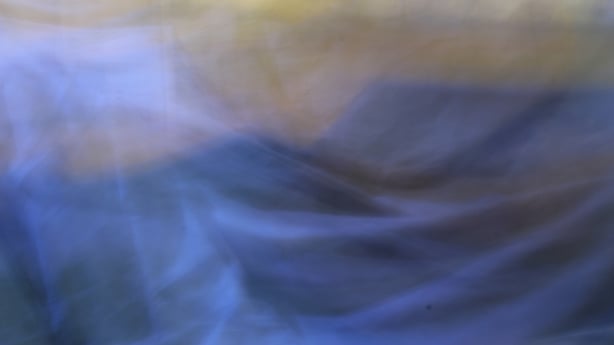
To approach perfection, one must capture a visual form whose proportions please both eye and inner ear. This is comparable to sound recording, where one seeks to capture and technically preserve delicate expression, musical breath, timbral nuance – a sound that produces the strongest sensory resonance and invites endless re-listening.In some cases, a high level of abstract synaesthetic thinking has led me to deliberately conceal the source or material of both the photograph and the music.
Without the author’s explanation, it may be impossible to identify what exactly was photographed, how it was produced, or which instruments and extended contemporary techniques were used. This returns us to the mystery at the heart of art itself – a mystery that, like synaesthesia, binds different forms of creativity together through invisible threads.
In today’s fragmented universe, photography and music remain fragments of visual space and time. Yet through synaesthetic connections, they turn not only toward the future through innovation, but also toward a distant past, searching for a world not yet fully divided – a world in which, as French psychologist.Théodule Ribot once suggested, coloured hearing was “the result of an incomplete differentiation between the senses of sight and hearing, and the accidental revival of a trait which, in a remote epoch, may once have been a general rule of humanity.”
Follow RTÉ Brainstorm on WhatsApp and Instagram for more stories and updates
The views expressed here are those of the author and do not represent or reflect the views of RTÉ