


SUSIE WILES HAD it right. On her assessment of Trump, at least. When she pulled back the Oval Office curtain for author Chris Whipple’s sensational Vanity Fair profile, her assessment of Trump was pithy and penetrating.
Trump, his Chief of Staff observed, “has an alcoholic’s personality. He “operates [with] a view that there’s nothing he can’t do. Nothing, zero, nothing.”
Over the past year, it’s become abundantly clear that Trump’s addiction is fuelled by two cravings: self-enrichment and self-aggrandisement. One feeds off the other.
And it’s also clear that the adulation and attention his first term delivered – the non-stop rallies, the cheers of thousands of MAGA supporters are no longer enough to slake his thirst for attention and adulation.
Intoxicated by power
Trump has always revelled in the exercise of raw power as President. But since his return to the White House, he has discovered the raw thrill of siccing the US military on global adversaries – or ‘blowing shit up’ as his former adviser Miles Taylor puts it.
When Israeli Prime Minister Benjamin Netanyahu bounced him into ordering strikes on Iran’s uranium enrichment facilities last June, it provided Trump with a much bigger dopamine hit than cracking the heads of Portland hippies.
The June 2025 strikes on nuclear facilities in Fordow and Natanz were reckless. But none of the worst-case scenarios predicted by foreign policy geeks and armchair generals – nuclear contamination and radiological casualties, the ignition of a regional war, terrorist attacks by proxy sleeper cells in US cities – materialised.

Pro-democracy iranians celebrate with chants and flags during a demonstration outside Iranian Embassy in London in solidarity with the regime change in Iran. Alamy Stock Photo
Alamy Stock Photo
The regime’s uranium enrichment programme wasn’t obliterated as Trump had claimed, but this clean, consequence-free strike at the heart of Iran’s nuclear ambitions thrilled and emboldened Trump.
It was always unlikely this would be the ‘one and done’ that Trump pledged to a sceptical MAGA base. That he was on a high from the outcome – hopped up on his hitherto untapped powers as Commander in Chief of the world’s biggest military superpower was evident in his reenergised appearances in the days that followed as he exulted in the ‘monumental’ and ‘spectacular’ success of Operation Midnight Hammer.
Soon, he was looking around for new targets. Pete Hegseth, his reckless and oft-ridiculed Defence Secretary and Marco Rubio, his quiescent Secretary of State and national security adviser, were only too happy to oblige.
It transpired you could blow up small boats in the Caribbean on a daily basis, whilst claiming victories in the war against drugs. The annihilation of fishermen or small-time drug smugglers by US drones and military provided more consequence-free fixes. They were the gateway drug for a much bigger dopamine hit; the audacious midnight raid that led to the decapitation of Venezuela’s authoritarian regime.
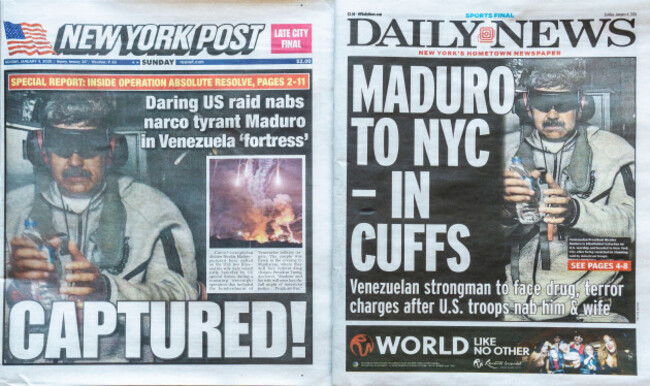
Headlines of the New York Post and the New York Daily News newspapers on Sunday, January 4, 2026 report on US raid on Venezuela capturing Venezuelan President Nicolás Maduro. Alamy Stock Photo
Alamy Stock Photo
Like the strikes on Fordow and Natanz, this high-risk, high stakes military-manouvre delivered another consequence-free triumph. For Trump, International rules and treaties had become nine pins that could be felled by the bowling ball of US military might.
Next up was Greenland. Trump’s mistaken assumption that the threat of military force would lead to Denmark and the EU’s capitulation led to a humiliating climbdown at Davos and the abandonment, for now at least, of that particular imperialist adventure. It was only a matter of time before Trump sought to scratch his imperialist itch with the ultimate high-stakes, high-risk goal: regime change in Iran.
Iran is not Venezuela
Operation Epic Fury hit its biggest target on Saturday with the annihilation of Iran’s Supreme Leader Ayatollah Ali Khamenei and an unconfirmed number of Iran’s top-tier leadership. But the US-Israeli war on Iran has catapulted the region into a deadly new spiral.
Iran has fired an hundreds of missiles from its inventory, more than half of which have been aimed at Israel. The UAE claims its THAAD defence system intercepted hundreds of ballistic missiles while dozens more targeted US and allied military bases in Kuwait, Jordan, Qatar and Iraq.
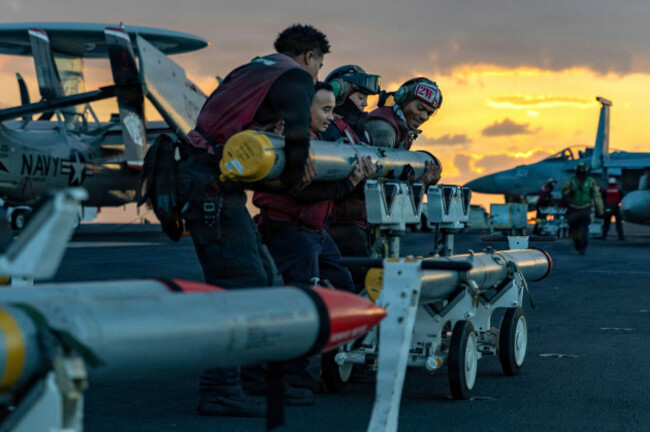
USS Gerald R Ford, International Waters. 28 February, 2026. U.S. Navy sailors on Operation Epic Fury. Alamy Stock Photo
Alamy Stock Photo
A report from the American Enterprise Institute’s Critical Threats Project has indicated that a decrease in the number of Iranian missiles fired over the past two days suggests that ‘US-Israeli efforts to degrade Iran’s retaliatory capabilities may be succeeding.”
Four American troops were killed in an Iranian strike on a US military base in Kuwait in the early stages. Three US military planes were also shot down in a ‘friendly fire’ incident by Kuwaiti air defences, but the Pentagon indicated that all six crew members survived.
The US’s goal as set out by Trump and Hegseth is threefold: destroy Iran’s navy, its inventory of ballistic missiles and its munitions manufacturing systems and permanently obliterate its nuclear ambitions.
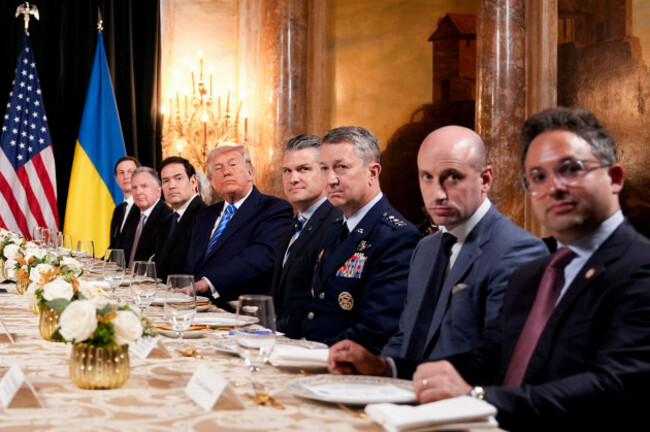
Trump with Jared Kushner, Steve Witkoff, Susie Wiles, Marco Rubio, Pete Hegseth and Chairman of the Joint Chiefs Air Force Gen. Dan Caine, White House deputy chief of staff Stephen Miller and Josh Gruenbaum. Alamy Stock Photo
Alamy Stock Photo
Iran’s navy could effectively shut down the Strait of Hormuz by littering it with mines that would render it impassable for the tankers that ferry 20% of the world’s crude oil supplies through its waters each day, leading to a surge in global oil prices.
And both Trump and Netanyahu have separately claimed that Iran is actively developing intercontinental missiles with a range of up to 8,000 km, a claim that has not been verified by US intelligence or military analysts. However, Iran does have an arsenal of between 1,000 and 2,000 medium range ballistic missiles with a range of between 1000 and 3000 km.
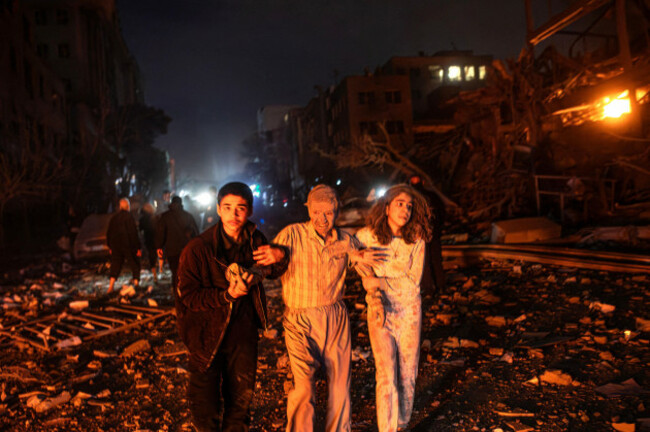
Trump and Hegseth have variously put a timeline for the realisation of these goals at somewhere between a few days and a few weeks. But the US doesn’t appear to have any strategy or plan should the country of 93 million descend into anarchy and chaos, or if the decapitated regime remains in place under new leadership and seeks to maintain control of the population with another brutal crackdown.
Alamy Stock Photo
Alamy Stock Photo
The US President’s appetite for engagement is largely defined by the optics of victory. Having taken out Iran’s leadership, he’s made it clear that he believes the US has no obligation to help usher in a new the rest is up to the Iranian’s themselves. But there is no organised, armed opposition in Iran. Almost half a century of brutal authoritarian rule has seen to that.
In a briefing Monday, Defence Secretary Pete Hegseth made it clear that the US has no intention of sticking around for any democratic nation building, echoing Trump’s call to Iranians civilian population to take back control of their government and their military.
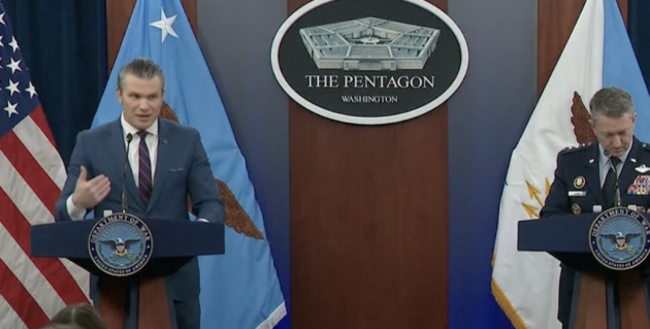
Hegseth and Chairman of the Joint Chiefs Air Force Gen. Dan Caine speaking at The Pentagon Monday.
“We hope the Iranian people take advantage of this incredible opportunity. President Trump has been clear; now is your time,” he said. “To Iranian security forces: choose wisely. President Trump has also been clear about your fate in either direction.
But Hegseth’s remarks directed at a US audience have little relevance for Iranians civilians or its military. There is no occupying or peace-keeping force to which the Artesh or the Iranian Revolutionary Guard Corps could surrender, even if it were minded to do so.
What do Americans think?
If Trump does achieve his goals within a short timeframe with minimal US casualties and little impact on the wallets of American voters, the operation may yet bolster his standing at the polls. But few military or political plans survive contact with the battlefield, and US troops in regional bases are still vulnerable to attack, even if there are no boots on the ground in Iran.
So far, it seems a significant swathe of both the American electorate and its political class is keeping their powder dry, waiting to see what happens next before pronouncing judgment on Trump’s decision to plunge America into a war that has violated international law and bypassed the US Congress. Early polling suggests that just under one in four Americans surveyed approve of Trump’s decision to go to war with Iran, while 43% disapprove and 29% volunteered no opinion at this point. That latter group will prove critical to Trump’s and likely the GOP’s mid-term fortunes.
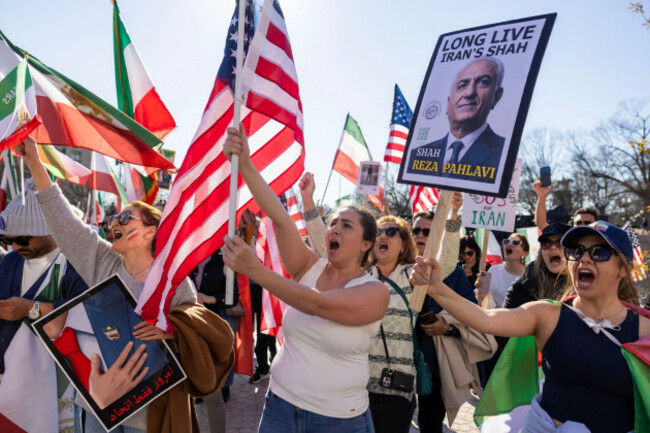
Hundreds of supporters of exiled Crown Prince of Iran Reza Pahlavi gathered at the World War I Memorial in Washington, DC, on Saturday, February 28, 2026. Alamy Stock Photo
Alamy Stock Photo
Trump’s supporters are unlikely to be unduly bothered by his decision to once again flout international law and norms, shut out America’s allies and bypass Congress. Ultimately, their response to Trump’s decision to attack Iran will depend on two main factors: the number of US casualties and whether the war sends energy prices spiralling. A third critical factor relates to the US intelligence community’s long-standing concerns about Iran’s terrorist sleeper cells in the US.
If the war triggers attacks on the American homeland, the blame will be placed squarely on Trump’s shoulders.
Congressional Republicans have so far overwhelmingly sided with Trump, with the caveat that they would like to hear more information on the strategy and endgame.
A spokesperson for the Departments of Defence and State has indicated that Hegseth and Rubio will provide classified briefings to the House and Senate, but Congressional Democrats and a handful of Republicans are calling for a vote to restrict Trump’s war powers. Even if successful, it’s unlikely to make any real difference, given the broad discretionary powers that are granted by the Constitution and various laws passed by Congress.
But the attacks triggered deep divisions between various sectors of Trump’s base. Tucker Carlson, the hugely influential conservative podcaster and Trump supporter, blasted Operation Epic Fury as ‘absolutely disgusting and evil’. Marjorie Taylor Green, whose relationship with Trump ruptured last year over his foreign adventures but still remains popular with the MAGA isolationists, slammed the strikes and the deaths of US soldiers in Kuwait as ‘absolutely unnecessary.’
Steve Bannon, another influential MAGA figure and former member of Trump’s inner circle, hosted several conservatives on his show who criticised Trump’s decision to join forces with Israel, including Erik Prince, the founder of the notorious Blackwater private military outfit and Curt Mills, executive director of The American Conservative, who has a big following amongst younger Trump supporters.

Steve Bannon, Marjorie Taylor Greene and Tucker Carlson. Alamy
Alamy
Prince, whose Constellis Holdings company has pitched Trump for contracts to detain and transport immigrants to prisons in countries like El Salvador, pronounced himself ‘disappointed’ by Trump while Mills reminded his supporters of Charlie Kirk’s vehement opposition to Trump’s June 2025 strikes.
Noting that scores of ardent Trump supporters from the MAGA manosphere took to X to voice their anger, Mills added: “If you accept that it was a podcast bro election, it is relevant that the podcast bros hate this.” Pushback from the base he said could lead to ‘no one going to the polls’ in the midterms.
Blake Neff, Charlie Kirk’s former producer and friend, was more circumspect. While he claimed “right-leaning” friends were expressing outrage at the attacks, he concluded, “If this war is a swift, easy and decisive victory, most of them will get over it. But if the war is anything else, there will be a lot of anger.”
Marion McKeone is an award-winning journalist, writer and documentary maker.