


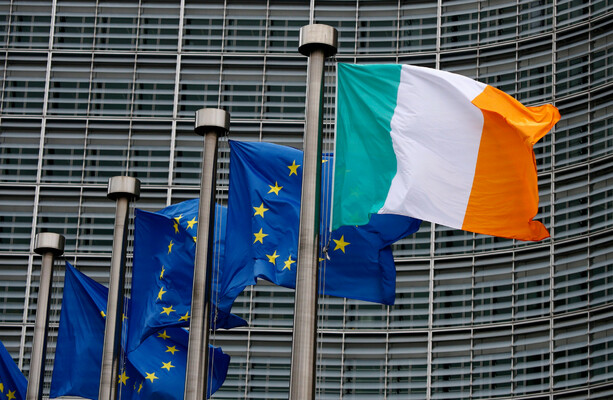
THERE IS A significant possibility that sparks will fly as the relationship develops between our new president and our government, notably on foreign policy issues. Attitudes to the European Union could be a flashpoint.
We have to allow our new president time to settle in as well as the benefit of some doubt. She may be less confrontational with the government on EU policy than some of her previous stances suggest. She might genuinely seek to represent all the Irish people, as she insists, rather than just those who share her strong euroscepticism. I wouldn’t count on it, but it’s possible.
The understandable disappointment in Ireland at the EU’s inability to take a stronger stance on Gaza has had an impact on public opinion here. The EU’s inaction was due largely to the fact that all of its foreign policy decisions necessarily require unanimity, a requirement of which Ireland, including those who most strongly criticise the EU on the Gaza issue, has always been broadly supportive.
Even on the proposed trade measures against Israel, it has not been not possible to cobble together the necessary qualified majority for the EU to act. It’s not a matter of a monolithic “EU” getting it wrong. It’s about the interplay between the views of member states, several of which carry an understandable historical guilt in relation to the Holocaust, and about the decision-making procedures we have all signed up to.
However, there is no suggestion that the overwhelming majority of Irish people remain anything other than strongly pro-European. President Connolly, during her campaign, felt it necessary to claim to be “pro-European”. Europe may well be one of those areas in which the electorate will be happy to have a government that continues to shape and manage Ireland’s substantive policy and a president with some leeway to adopt a questioning and sceptical stance.
The government will need to handle its relationship with the president carefully in this, as in other areas.
Depending on the president’s pronouncements, it may involve challenging her views from time to time. It may prove best, for the most part, to avoid challenging her directly.
However, irrespective of the future relationship between the government and President Connolly, it is clear that the government parties must learn to make the case for Europe far more consistently and effectively than they did during their failed Presidential election campaigns.
One of the obvious failures of the Fine Gael and truncated Fianna Fáil campaigns was a manifest inability to lay any serious glove on Catherine Connolly’s contestable claim that she is “pro-European”.
Government parties focused more on the red herring of her work as a barrister than on the existential importance of Ireland’s commitment to and influence in the European Union. The question is why, when the Humphreys campaign did raise the European issue, its argument was limited to generalities rather than hammering home exactly why unreasonable criticism of our European partners and voting against previous EU treaties is not compatible with a broad claim to be “pro-European”.
It is vital to reflect on why these points were not effectively made during the election campaign. I believe, reluctantly, that it is because most political representatives of our genuinely pro-European parties have never devoted sufficient priority and energy to truly understanding the complex nature of the EU or to developing the ability to explain that complexity in relatively simple terms to the public.
Successive governments have represented Ireland’s interests well in Brussels. They have shown the ability to rise to specific European challenges such as Brexit. They will no doubt run a good Irish EU Presidency next year. However, what has been lacking is consistent ongoing prioritisation of the EU, including in domestic public debate.
Many politicians are willing to make the case for Europe but not many have the capacity to do so effectively.
They need to explain precisely why the European Union is not about posturing from the sidelines, why it’s not about addressing a domestic audience through a loudhailer. Rather, the EU is an extraordinarily complex negotiating context, admirable but imperfect, in which each member state – including Ireland – seeks to advance its interests and Europe’s collective interest, through intelligent negotiating tactics, mutual respect, carefully constructed alliances and inevitable compromises.
They need to emphasise that Ireland does not face a choice on the EU between, on the one hand, meekly accepting everything that emerges in Brussels and, on the other, grandstanding from a distance.
Rather Ireland has an important place at the European negotiating table.
Irish politicians and officials attend dozens of meetings every single day at which Irish values and interests are advanced and our point of view is taken significantly into account.
In promoting our interests, Ireland has limited but important negotiating ammunition that is depleted every time significant voices here badmouth EU partners, when we show no understanding for their deepest concerns, including on security, when we behave as if the solidarity we received on Brexit does not have to be reciprocated.
With, on the one hand, Trump’s assault on international norms and institutions, and, on the other, Putin’s army marauding across our continent, the European Union is more important now than ever – both for its own citizens and for the wider world.
It is of some reassurance that the government will continue to be responsible for shaping and implementing Ireland’s European policy. However, especially to the extent that our new President may choose to make potentially damaging pronouncements, the Government, and others who share a genuine commitment to Europe, must be more assertive, courageous and confident in making the case.
Bobby McDonagh is a former Irish Ambassador to the EU, UK and Italy. He is an executive coach and commentator on subjects around the EU and Brexit.