
Environment
Nasa’s Artemis II mission: launch date revealed and meet the crew heading back to the Moon


Pallab Ghosh,Science Correspondentand
Alison Francis,Senior Science Journalist

 NASA
NASA
NASA is preparing to launch the Artemis II mission, the first crewed Moon mission in over 50 years, potentially as early as the first week of February. The Space Launch System (SLS) rocket and Orion capsule were recently moved to the launch pad, marking a key step in pre-flight preparations. Engineers will now begin connecting various ground systems and conduct a critical fueling test known as a wet dress rehearsal at the end of January. If everything proceeds smoothly, the earliest launch date is February 6, with other available windows in March and April. Launch timing also depends on the Moon’s position, offering limited launch windows each month.
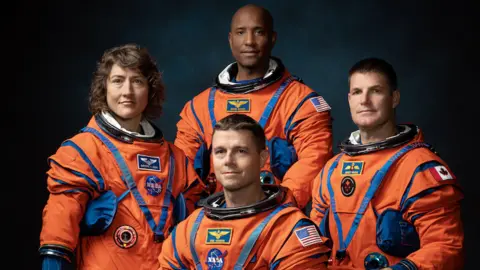
You’ll see the Artemis II crew test Orion’s systems during their 10-day mission, which will take them farther into space than any humans have traveled before. The team includes NASA astronauts Reid Wiseman, Victor Glover, Christina Koch, and Canadian astronaut Jeremy Hansen. Their work will involve checking life-support and propulsion systems, manually flying Orion in Earth orbit, and sending back health and radiation data while living in space. Though the capsule won’t land on the Moon, this mission is key to preparing for future lunar landings.
Artemis II sets the stage for Artemis III, the mission that will attempt a Moon landing no earlier than 2027, though 2028 is more realistic. NASA hasn’t yet finalized the lander, with SpaceX’s Starship and Blue Origin’s design in the running. New spacesuits are still in development. Artemis III will target the Moon’s south pole—an area of scientific interest and potential long-term exploration. Later missions like Artemis IV and V will support sustainable Moon presence by building the Gateway station and deploying new robotic technology.
You might recall that the last time humans walked on the Moon was in 1972 during Apollo 17. Since then, no astronaut has returned, and only five Apollo-era Moon travelers are still alive today. The original space race focus on beating the Soviet Union faded along with funding. Today’s Artemis program reflects a shift toward long-term goals and international partnerships aimed at maintaining a steady human presence on and around the Moon.
If you’re wondering about global ambitions, other countries are also looking to reach the Moon. European and Japanese astronauts are set to fly on future Artemis missions, while China is developing its own spacecraft, aiming for a Moon landing near the south pole by 2030. Russia and India also have plans, though timelines may vary due to technical and financial constraints. India, following recent success with Chandrayaan 3, hopes to send astronauts to the Moon by 2040 as part of its broader space ambitions.