


TWO TECH COMPANIES made up 40% of corporation tax receipts in 2024 but it’s been warned that the outcome of future tech profits is “highly uncertain” and could fall sharply.
That’s the warning delivered today by the Irish Fiscal Advisory Council (Ifac), the government’s independent budget watchdog which assesses public finances and the economy.
Previous research suggested that three companies accounted for around a third of corporation tax but the latest findings from Ifac finds that this increased to almost half (46%) in 2024 – equivalent to around €13 billion.
These three companies are in the tech and pharmaceutical sectors, but the two largest in terms of corporation tax are tech companies – Ifac has not identified the companies.
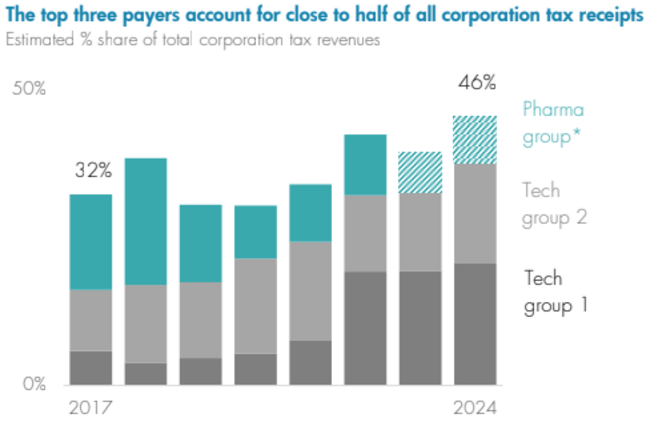
Breakdown of top three companies for corporation tax receipts Ifac
Ifac
Apple has previously said that it is the biggest taxpayer in Ireland.
Ifac has estimated that these two tech companies paid close to 40% of corporation tax in Ireland in 2024, equivalent to around €11 billion.
Corporation tax receipts almost doubled between 2021 and 2024, even when the windfall from the Apple tax judgment is excluded.
However, the government has long been warned against over-relying on corporation tax and Ifac has today warned that as corporation tax revenues become even more concentrated in a small number of companies, they also become riskier.
“All three of the current top corporate taxpayers first arrived in Ireland decades ago,” said Ifac.
“Ireland is a key part of their group structures. However, this may not always remain the case.”
‘Performing strongly’ but risks remain
Ifac noted that the three companies that account for around half of corporation taxes “continue to perform strongly” and that “profits in the tech sector are likely to increase further”.
It also states that the pharma sector is also likely to continue to benefit from the “surge in demand for weight-loss and diabetes medicines” and that “Ireland appears to be a key manufacturing base for the active ingredients used”.
Ifac also noted that the 15% minimum effective tax rate for large corporations will lead to increased corporation tax from 2026 onward.
It’s suggested that this higher tax rate could amount to an additional €5 billion in corporation tax receipts.
But Ifac has also pointed towards “clear downside risks” and warned that the tech sector could see a downturn in profits.
While tech companies are currently making huge investments in artificial intelligence (AI), Ifac said AI “may not deliver the high returns anticipated”.
The International Monetary Fund recently warned that if expectations about AI growth turn out to be overly optimistic, an abrupt market correction could be triggered.
Meanwhile, Ifac also warned that tighter regulation on the tech sector, slow sales for new products or even a change in senior leadership could reduce profits.
Ifac also said efforts to reduce the cost of branded drug products in the US could reduce profits in the pharma sector.
US president Donald Trump has recently announced a series of pricing deals with top drug companies, convincing them to commit to pricing that matches the lowest price offered in other wealthy nations.
Ifac meanwhile stated that tariffs on pharmaceutical products could reduce profitability in the sector, but acknowledged that this appears less likely, as most major firms have already made bilateral arrangements with the Trump administration.
Brian Cronin, Economist at Ifac and author of the corporation tax research, noted that Ireland’s corporation tax has become reliant on just three companies.
“These companies continue to perform strongly,” said Cronin, “but their profits and the taxes they pay remain subject to significant uncertainty.
“As a result, corporation tax receipts could be substantially higher or lower than current levels in the medium term.”