

JUST 10% OF Ireland’s historic landfills have been certified by the Environmental Protection Agency (EPA) over 15 years since the regulations were introduced, despite evidence some are polluting waterways.
The rules are meant to ensure that these old landfills – found in every county in Ireland – are not causing or are likely to cause environmental damage in the future.
But the failure to certify the majority of Ireland’s historic landfills means they are at risk of leaking toxic waste and causing significant environmental pollution to surrounding ecosystems and waterways.
Our investigation found that there are over 260 historic landfills left in limbo, many of which have been categorised as high or moderate risk of causing environmental damage.
Some have been redeveloped into public parks, football pitches and even a popular tourist attraction.
Others are seemingly abandoned, like one in Blarney, Cork, which sits on land sandwiched between two schools, though this landfill has been classified as low risk by Cork County Council.
Landfill leachate, which is caused when rainwater seeps through the waste in a landfill, extracting harmful chemicals and contaminants, can cause substantial environmental damage if it leaks from the landfill area.
A buildup of landfill gas from the decomposing waste can also pose an environmental and health risk due to the release of methane and carbon dioxide.
Experts told The Journal Investigates that these landfills may also contain waste that is now banned, potentially releasing persistent chemicals into the environment.

The Journal Investigates partnered with Investigate Europe, Watershed Investigations and outlets across the continent to uncover the scale of these old waste sites.
There are estimated to be up to 500,000 landfills across Europe, around 90% of which predate modern European pollution control legislation.
Their exact locations, however, remain broadly unknown, largely due to a lack of consistent data and the fact that many sites have been covered over.
The cross-border investigation analysed data from Freedom of Information requests, government agencies and public sources to locate more than 60,000 sites across the continent.
Many of these are likely to be historic landfills which contain a range of industrial, commercial, domestic, hazardous and liquid sludge and could be leaching into the environment.
A huge number of landfills, including some in Ireland, are also located in flood zones or in areas experiencing coastal erosion.
They are also present in special areas of conservation, further raising the risk of pollution and harmful chemicals contaminating waterways.
A spokesperson for the EPA told The Journal Investigates that these “landfills continue to pose a potential risk of environmental pollution which must be addressed”.
They added that high-risk sites are prioritised by the agency, but “certification timelines vary based on the quality of applications, the complexity of the site and the resources available.”
Investigations like this don’t happen without your support… Impactful investigative reporting is powered by people like you.
What is a historic landfill?
A historic, or closed, landfill is a landfill site operated by a local authority without a waste licence between 1977 and 1997.
The EU Landfill Directive, adopted in 1999, banned unlined landfills and created strict waste acceptance criteria. But prior to this, there were fewer pollution containment measures.
The regulations that underpin this definition state that local authorities must identify and register the closed landfill sites in their area before applying to the EPA for what’s known as a certificate of authorisation.
This certificate is supposed to retrospectively introduce control measures through remedial works to ensure the risk of these landfills causing environmental damage is contained.
But our investigation has found there are significant failures to submit historic landfills to the EPA for certification.
Some 87 historic landfills categorised as having a high or moderate risk of causing environmental damage have not been submitted by local authorities for a certificate of authorisation.

One of these landfills, categorised as being high risk, sits on the River Blackwater in Cork.
It lies close to where up to 46,000 fish died due to an unknown chemical irritant in the water, although it should be stressed that their deaths are unlikely linked to its presence.
A spokesperson for Inland Fisheries Ireland (IFI) told The Journal Investigates that this landfill “did not form part of the IFI investigation into the recent fish kill on the River Blackwater”.
They added that “IFI has no record of engagement with such a site in recent decades.”
A spokesperson for the EPA added that the fish were found upstream of the landfill, meaning that it is unlikely to have been the cause.
The failure by local authorities to submit historic landfills to the EPA isn’t the only delay in making them safe.
Fourteen historic landfills submitted to the EPA for certification by local authorities are still awaiting a decision more than 10 years after being submitted.
A further four landfills have been waiting for certification for more than five years.
Such is the delay in granting these certificates that consulting engineers hired by local authorities for the remedial works are no longer attached to projects, forcing them to engage in rehiring through the public procurement process.
This means that some councils are forced to spend more money and resources attempting to fix their former landfills because of delays.
Dumped waste causing environmental damage
Even though waste hasn’t been dumped at these sites in decades, some have been linked to pollution and environmental damage.
In Galway, a historic landfill was considered to be a potential source of pollution to the adjacent Gort River, according to a site investigation in 2021.
Photos of the dumped waste, which sits metres away from the river and a popular walking trail, lay bare the scale of the problem.
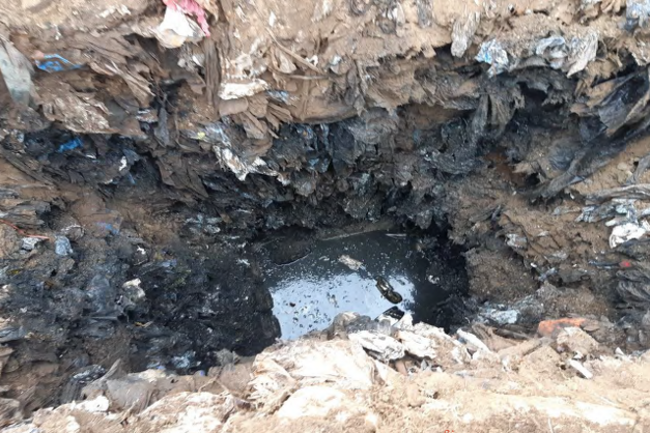
A trial pit dug at a historic landfill in Gort, Galway, revealing thousands of tonnes of waste dumped by Galway County Council during the 1980s. Galway County Council
Galway County Council
It demonstrates that while many historic landfills are now covered in grass and foliage and appear to be benign, mountains of potentially hazardous waste lies just below the surface.
Galway County Council applied for a certificate of authorisation from the EPA in 2021 and waited over three years before a draft certificate was issued, which will require the council to carry out remedial works at the site.
Many historic landfills wait far longer for certification from the EPA.
Three sites in Cork applied back in 2013 and have yet to receive a decision despite evidence that two of them are leaking into nearby waterbodies and causing pollution.
The Clountreem Landfill, near Castletownbere in West Cork, is “adversely affecting the water quality of the Clountreem Stream and is the source point of pollution to the stream”, according to a report from 2009.
In October 2024, Cork County Council informed the EPA that “due to the considerable time delay”, they no longer have consulting engineers on the project and must engage in the public procurement process to rehire.
It’s a similar story at a landfill in Dunmanway, where the adjacent surface water is being impacted by the landfill.
Both landfills are said to be contributing to elevated ammonia levels in nearby water sources, according to site investigations carried out by Cork County Council.
Excess ammonia can be toxic to fish, disrupting aquatic ecosystems and even poses risks to human health by contaminating drinking water sources.
Dr Jenny Lawler from Dublin City University’s School of Biotechnology told The Journal Investigates the evidence of increased ammonia indicates “that there’s ongoing breakdown and biological activity happening in the landfill”.
She added that these landfills likely contain things that are banned nowadays, such as electrical components and plastics. Lawler said:
They’re not allowed to be used in manufacturing, but they’re being allowed to go out into our environment and into our waterways.
A third historic landfill in Clonakilty has also been waiting over 10 years for certification, even though part of the site has already been redeveloped into a popular tourist attraction.
Initial site investigations raised concerns about the proximity to the nearby inlet and the buildup of landfill gases, but these were later dismissed as low risks.
A spokesperson for Cork County Council told our team that they “submitted certificate of authorisation applications in 2012 and 2013 to the EPA for approval”.
They added, “once authorisation is granted, we envisage the appointment of consulting engineers to assist in the remediation process.”
Bernie Connolly, co-coordinator with advocacy group The Environmental Forum, said that these landfills being situated so close to waterways highlights “a legacy of poor planning” that failed to take into account the impact of climate change.
In total, 18 landfills submitted to the EPA have been waiting more than five years for certification, including 14 that applied more than ten years ago.
And the EPA has issued 944 extension notifications to local authorities for the 57 historic landfills that have applied for a certificate of authorisation but have not yet received one.
A spokesperson for the EPA told our team that they must “determine the adequacy of the risk assessment submitted by local authorities and ensure that proposed remediation measures are appropriate”.
They added that “additional information is frequently required from local authorities” which can cause delays and that “local authorities have lodged objections to over two-thirds (68%) of draft certificates of authorisation.”
Seven draft certificates have been issued for historic landfills applications currently with the EPA.
More historic landfills left in limbo
But this issue isn’t just a problem for the EPA.
Our investigation found that there are 208 historic landfills identified by local authorities that haven’t even applied for a certificate of authorisation.
Many of these are also categorised as high or moderate risk of environmental damage, though it is possible for this risk rating to change (in any direction) following further assessment.
As part of their responsibilities under the regulations, local authorities are required to identify historic landfills in their area and submit them to a national register.
To uncover the scale of the problem, The Journal Investigates asked every local authority in Ireland to provide a list of historic landfills in their area.
In total, they provided a list of 298 historic landfills; however, the EPA claims that just 275 landfills have been registered.
157 of these have been classified as either high or moderate risk of causing environmental damage, and just 31 have been licensed by the EPA.
Three local authorities – Carlow, Leitrim and Offaly – have not submitted any of their historic landfills to the EPA.
Nine other councils have not applied or licensed more than 75% of their old landfills.

Laois County Council is the only local authority to have applied for a certificate of authorisation for all of its historic landfills, though none have yet been granted by the EPA.
Our team asked local authorities why they hadn’t submitted their historic landfills to the EPA.
They cited issues with conducting the environmental assessments required for the application as well as funding difficulties to carry out the necessary remedial work, but stressed they were committed to ensuring these sites are made safe.
A spokesperson for the Department of Environment told The Journal Investigates that both local authorities and the EPA “are required to resource themselves appropriately” to certify historic landfills.
€205.5 million has been provided to local authorities and the EPA to carry out landfill remediation, the spokesperson continued, adding that €18 million had been allocated this year, “supporting almost 120 projects through different stages of environmental risk assessment, regularisation and final remediation works”.
The Journal Investigates
Reporter: Conor O’Carroll • Editor: Noel Baker • Social Media & Video: Cliodhna Travers • Main Image Design: Lorcan O’Reilly
This story is part of a collaborative project among several media outlets led by Investigate Europe and Watershed Investigations. It was supported by Journalismfund Europe.