


THE GOVERNMENT IS examining potential evacuation options for Irish citizens in the Middle East as conflict in the region intensifies and airspace closures continue to disrupt travel.
Minister for Foreign Affairs Helen McEntee said her department is working “around the clock” to support citizens and that safety will determine any next steps.
“We are exploring options to try and get as many people home safely,” McEntee told reporters outside Government Buildings this morning.
“There have been a small number of flights that have gone from within the UAE. We know that there have been a number of Irish passenger passengers on those flights, and we expect that there will be a smaller number of flights again.
“Today, we are looking at chartering flights, not just ourselves, but also with European countries, and it’s important that we explore all of these options.”
McEntee said the department estimates that between 22,000 and 23,000 Irish citizens are currently in the region, including long-term residents, holidaymakers and those transiting through airports.
Among them, around 12,000 reside in the UAE.
McEntee added that the government is identifying and prioritising vulnerable cases, including older people and those requiring medical assistance.
“The advice has not changed. It is to remain in shelter and to not remove yourself from the accommodation that you’re in,” McEntee said.
As things stand, there is no planning for an Irish Emergency Consular Assistance Team (ECAT) to be dispatched to bring trapped Irish citizens out of the affected countries.
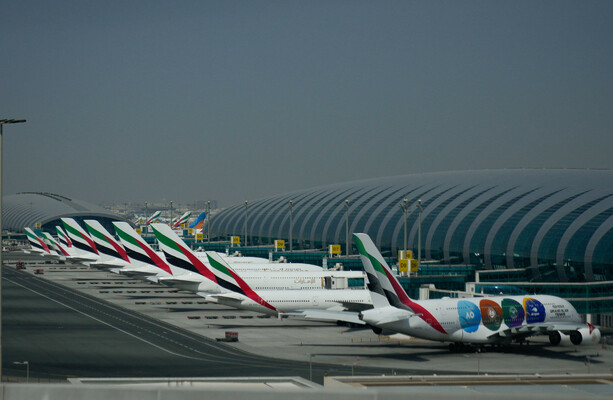
Etihad, Emirates and Qatar Airways have cancelled flights to and from Dublin, disrupting key routes through the Middle East.
Emirates operates three daily Dublin-Dubai flights, Etihad up to two daily return services to Abu Dhabi, while Qatar Airways runs up to three daily return flights to Doha.
Many passengers use these hubs to connect onwards to Australia, the Far East, Africa, India and the Philippines.
The suspensions have left travellers stranded worldwide.
Tánaiste Simon Harris said “all options are on the table” but warned that airspace restrictions pose significant challenges.
“It may not be possible to get flights into the epicentre of the conflict,” Harris said.
“We’re looking at all of the options now, on what the most efficient and effective option is – there are a number of options,” Harris said.
He added that a small number of Irish citizens have already left on commercial flights, though capacity is limited and priority is being given to medically vulnerable passengers.
Citizens with concerns can contact the Department of Foreign Affairs’ consular team in Dublin at +353 1 408 2000, while those in the region are advised to contact their local Irish embassy.