


GOVERNMENT MINISTERS CHECKED out bread making today at the popular Dublin café Bread 41 as they announced an initiative to financially back new flour mills in Ireland.
Milling was once widespread in Ireland, but a reliance on imported grain means Ireland now has only one industrial-scale flour mill.
Currently, Ireland imports approximately 80% of its flour, largely from the UK and France. Enterprise Minister Peter Burke said today that the cost of importation has increased by around €10m per year due to Brexit.
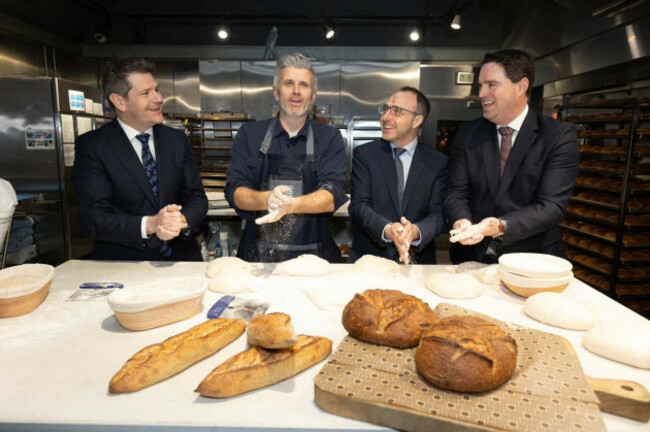
Eoin Cluskey, co-owner of Bread 41 (second from left) with ministers Peter Burke, Robert Troy and Martin Heydon Julian Behal Photography
Julian Behal Photography
The scheme aims to establish four mills in different areas of the country, and will provide grants of potentially up to €5m per mill.
The move is being led by Burke and Agriculture Minister Martin Heydon and comes as part of efforts to strengthen the competitiveness, sustainability and resilience of the bakery value chain.
Burke said today that the Irish bakery market is worth €995m, with 7,000 people employed in over 600 companies. He said the investment will create capacity to mill up to 80,000 tonnes of flour per year in Ireland.
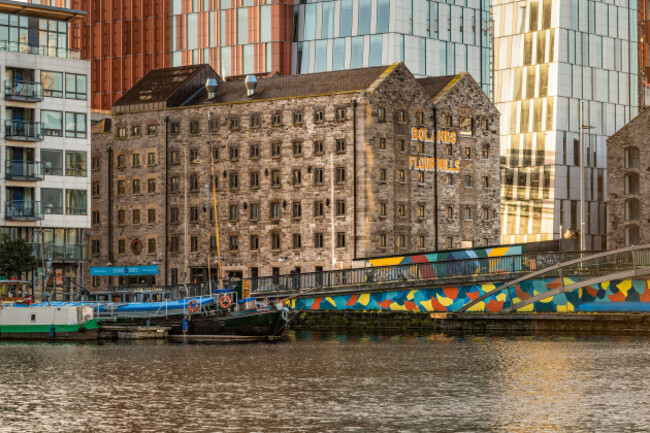
Bolands Mills, a key historical location from the 1916 rising, ceased production in 2001 and is now a mixed-use development. Alamy Stock Photo
Alamy Stock Photo
“[It’s] a very significant commercial incentive to get the sector back up and running again, and will underwrite the growth of the thousands of jobs in the sector and will provide a sustainability piece and key markets for our farmers as well, which is very important,” Burke said.
Heydon said the move will help the tillage sector and encourage more growers by allowing grain suppliers to work with Irish processors rather than being so dependent on global grain prices.
The move comes amid concerns about food security globally and increased shocks to global supply chains.
The price of wheat soared by 55% when Russia invaded Ukraine in 2022. At the time, then agriculture minister Charlie McConalogue asked farmers to plant wheat, barley and other grains to offset a possible food security crisis.
Demand for flour also grew during Covid lockdowns when there was an uptick in interest in baking. RTÉ reported in 2020 that the Odlums Flour mill in Co Laois was working 24/7 for the first time in history to meet demand.