

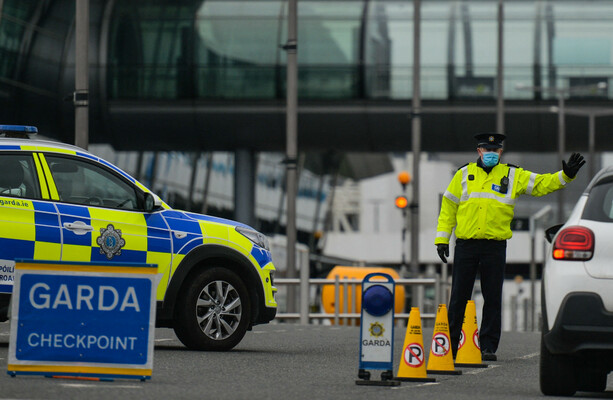
A FATHER AND son who lost an appeal over their failed High Court bid to challenge fixed penalty notices they received for allegedly breaching Covid regulations by travelling to Dublin Airport in 2021 have been ordered to pay the State’s legal costs.
Nicolae and Florin Mazarache, of Lealand Meadows, Clondalkin, Dublin, were travelling to Spain to visit family members on 17 April, 2021, when they were stopped at the airport by a garda.
They were later issued with the notices alleging they had “committed an offence of movement of persons” at a port or airport contrary to the 1947 Health Act (as amended).
A fixed payment of €2,000 was applied, but the Mazaraches chose not to pay the fixed penalty and instead brought judicial review proceedings, claiming there was a fundamental unfairness in the failure of the fixed notices they received to either specify or particularise the offence.
In February 2024, the High Court dismissed their judicial review application and lifted an injunction halting their prosecution in the District Court.
The Mazaraches appealed this, but last October the Court of Appeal dismissed their case. Ms Justice Nuala Butler found it would be counterproductive to have District Court cases determined on a pre-emptive basis by the High Court in response to judicial review proceedings issued before any criminal prosecution begins.
At a costs hearing before the Court of Appeal today, counsel for the Mazaraches, Feichín McDonagh SC, said this was a very unusual case. He said it was the first occasion when a fixed penalty charge of this nature was adopted, with the appellants facing having to pay €2,000 for a document that did not identify a criminal offence.
He said that the High Court had found that the notice did not comply with the act, with the Court of Appeal subsequently ruling that this was a matter for the District Court to resolve.
McDonagh said that this could have enormous consequences for the State, as the process could be used again.
Replying to counsel’s submissions, Ms Justice Butler today said that as the procedure was part of the special provisions during Covid regulations, it did not follow that the State would reenact it.
McDonagh said that a principle had been established, with the Court of Appeal previously ruling that if the State had adopted a fixed penalty procedure, this was a matter for the District Court to resolve.
“It is strange that one would serve a fixed penalty notice without identifying an offence,” counsel said, going on to say that this failure had not affected the circumstances his clients found themselves in.
Counsel for the State, John D Fitzgerald SC, said that what had previously been before the Court of Appeal was not the issue of compliance with the fixed penalty notice but the consequences of it.
He said that the High Court had found that no unfairness resulted to the appellants, with the Court of Appeal subsequently ruling that this matter should have been dealt with in the District Court.
In delivering the court’s ruling, Ms Justice Butler said that the opposed costs order should be made, as this case did not meet the requirements of exceptional conditions.
Accordingly, the appellants were ordered to pay the costs of the State’s legal representatives in the case.