

THE EUROPEAN COMMISSION has proposed a financial package worth up to €210 billion for Ukraine, partly by using the cash value of frozen Russian state assets.
It comes as Ukraine’s allies seek way to keep Ukraine afloat as the war against Russia continues.
Earlier today, Nato pledged to buy hundreds of millions of dollars worth of US arms for Kyiv.
NATO chief Mark Rutte said it was positive that peace talks were ongoing but that the alliance should make sure that “Ukraine is in the strongest possible position to keep the fight going”.
For the EU, European Commission president Ursula von der Leyen said its loan proposal was the way to “dial” up pressure on Russian president Vladimir Putin, as peace talks struggle on without a clear result.
With today’s proposals, we can give Ukrainians the means to defend themselves.
And take forward peace talks from a position of strength.
We are putting forward solutions to support Ukraine’s budget and strengthen its defence industry ↓ https://t.co/rVwJoZEOEy
— Ursula von der Leyen (@vonderleyen) December 3, 2025
“We are proposing to cover two-thirds of Ukraine’s financing needs for the next two years,” von der Leyen said today.
The remainder is to come from other states.
“We have to increase the costs of war for Putin’s aggression and today’s proposal gives us the means to do this,” the Commission chief said.
Those Russian assets that the EU proposes to use – worth €165 billion – are currently held in Belgium.
However, the Belgians fear that the country may be held liable in the future for the use of the seized assets and its government has opposed the EU’s plan.
Its Foreign Minister Maxime Prévot told reporters at a meeting of Nato today that Begium has “the frustrating feeling of not having been heard”.
Trump unsure what comes next
US President Donald Trump said his envoys had a “very good” meeting with Russian leader Vladimir Putin on negotiating an end to the war in Ukraine, but cautioned that what happens next is unclear.
Trump’s envoy Steve Witkoff and his son-in-law Jared Kushner left the Kremlin with no breakthrough on a peace deal, following a lengthy meeting that lasted into the early hours of Wednesday.
“They had a very good meeting yesterday with President Putin,” Trump said, adding: “What comes out of that meeting? I can’t tell you.”
The Kremlin said the two sides had failed to find a “compromise” on the crucial issue of territories and that Ukraine’s participation in NATO remained a “key” question in the talks.
Ukrainian President Volodymyr Zelenskyy said that though a window of opportunity for peace has opened, it must be accompanied by pressure on Moscow.
“The world now clearly feels that there is an opportunity to end the war, and the current activity in negotiations must be supported by pressure on Russia,” he said in a regular evening address.
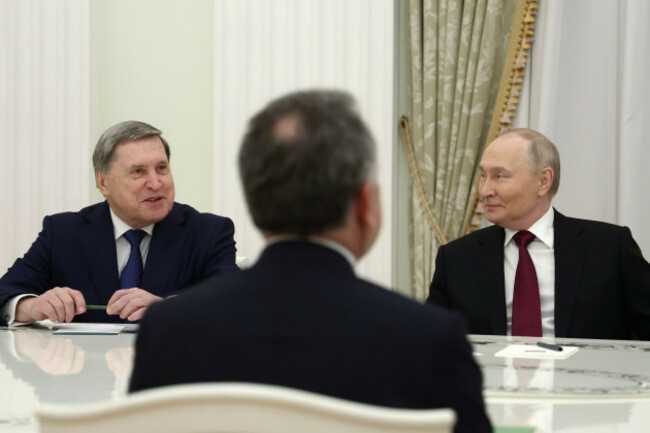
Russian President Vladimir Putin, right, and Russian presidential foreign policy adviser Yuri Ushakov, left, during talks with US special envoy Steve Witkoff Alexander Kazakov, Sputnik, Kremlin Pool Photo via AP
Alexander Kazakov, Sputnik, Kremlin Pool Photo via AP
The White House had previously voiced optimism about its plan to end Europe’s worst conflict since World War II but that hope appeared to fade today, with Moscow saying it had found parts of the plan “unacceptable”.
Witkoff and Kushner brought an updated version of a US plan to end the war.
The Kremlin said today that its army’s recent battlefield successes in Ukraine had bolstered its position in talks to end the fighting, as both Moscow and Kyiv prepared for more negotiations with the United States.
Russia’s advance in eastern Ukraine gathered pace last month and Putin has said in recent days that Moscow is ready to fight on to seize the rest of the land it claims if Kyiv does not surrender it.
“The progress and nature of the negotiations were influenced by the successes of the Russian army on the battlefield in recent weeks,” Kremlin aide Yuri Ushakov — who took part in the US-Russia talks — told reporters, including AFP.
“Our Russian soldiers, through their military exploits, have helped make the assessments of our foreign partners regarding the paths to a peace settlement more appropriate,” he added.
Moscow insisted it was incorrect to say Putin rejected the plan in its entirety.
It also said Russia was still committed to diplomacy, despite Putin’s stark warning that Moscow was prepared to fight Europe if it wanted war.
“We are still ready to meet as many times as is needed to reach a peace settlement,” Kremlin spokesman Dmitry Peskov said.
Battlefield state of play
Russian troops have been grinding forward across the front line against outgunned and outnumbered Ukrainian forces.
Earlier this week, Moscow claimed to have captured the important stronghold of Pokrovsk but a Ukrainian army unit fighting in the city said urban combat was still ongoing.
“The enemy is bogged down in urban combat for Pokrovsk and currently cannot seize the city using weapons,” the 7th Air Assault Corps said.
According to Ukrainian online map project DeepState, most of the city is occupied by the Russians.
European countries have expressed fears Washington and Moscow will reach agreements without them and have spent the last weeks trying to amend the US plan so that it does not force Kyiv to capitulate.
In Moscow, tensions with Europe were palpable, with Putin delivering an exceptionally hawkish statement on Tuesday.
“We are not planning to go to war with Europe, but if Europe wants to and starts, we are ready right now,” he said.
Britain has downplayed Putin’s hawkish messaging, calling it “yet more Kremlin claptrap from a president who isn’t serious about peace”.