


LAST UPDATE
|
2 hrs ago
THE FIRST ‘NO More Hotels’ protest party took place on the 10 August 2019 to highlight the fact that clubbing was indeed culture — and a culture worth saving.
We set it up at the time because we were sick of watching the eradication of places to dance in the city to make way for hotels. As a resident and business owner of Dublin City Centre, I was invested in living in a city that had life, creativity and community at its heart.
Whilst we remain the city’s biggest cheerleaders and applaud those who are actively working to make the city sing, it’s been tough to stay positive in the last few years, as the capital city loses much of what made it special in the first place.
The opening line on our first Instagram post was, “Too many cultural hubs in Dublin have been bulldozed to make way for just-for-profit hotels. The city is losing its late-night soul.”
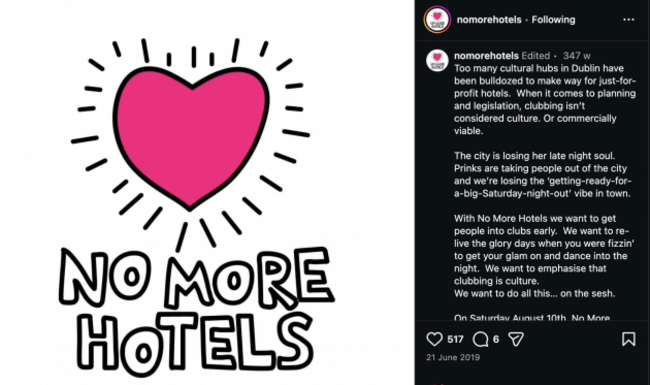
No More Hotels. instagram.com / nomorehotels/
instagram.com / nomorehotels/ / nomorehotels/
One, two, skip a few (years) — seven to be exact — and we are witnessing tensions between The Hoxton and Yamamori Izakaya. This is the perfect illustration of the David and Goliath battle the city has been facing when it comes to late-night, fun venues being threatened by developments for tourists.
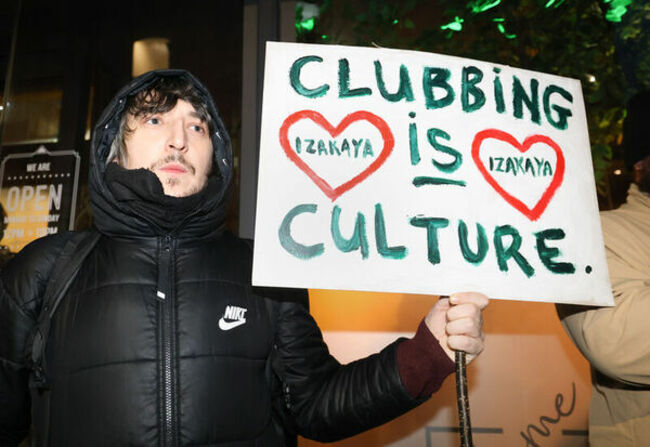
The injunction served by The Hoxton to Yamamori Izakaya over alleged noise complaints seems to be yet another tipping point reached for the people of Dublin, who have had enough of their city being sold off and taken over by the highest bidder.
A similar pushback took place in 2021, when The Cobblestone, an intrinsic part of Dublin trad culture, found itself at the centre of a planning saga. A nine-storey hotel was proposed surrounding the venue, prompting a strong response from residents and supporters. In the end, pressure won out, and the plans for the site were refused and withdrawn.
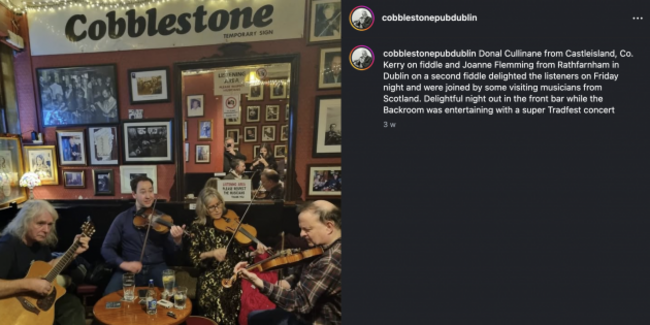
The Cobblestone. instagram.com / cobblestonepubdublin
instagram.com / cobblestonepubdublin / cobblestonepubdublin
Jane Jacobs, author of the seminal ‘The Death and Life of Great American Cities’ and widely regarded as the architect of the modern city, said:
“This is something everyone knows: A well-used city street is apt to be a safe street. A deserted city street is apt to be unsafe.”
‘A thriving city is noisy’
People have always loved the city of Dublin because of its bustling cultural richness. But that vibrancy is gradually being weakened, as more and more of the city centre is taken over by hotels, aparthotels, gated luxury student accommodation and co-living developments.
It’s as if a hush is descending over the streets. More and more lively Dublin streetscapes are being replaced by mostly empty, glass-fronted lobbies filled with unused foosball tables, depriving the streets of the safety usually provided by people going about their business.
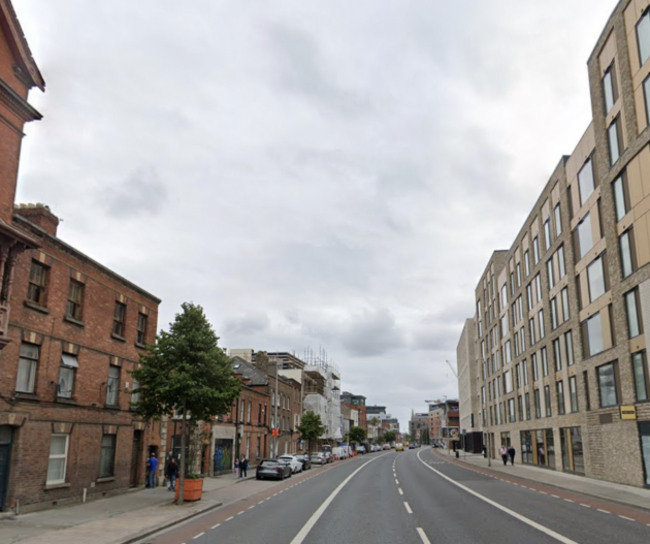
Many Dublin streets are now home to hotels. aparthotels and student accommodation, buildings that while modern in style, offer little to the local community. Google Maps
Google Maps
The quietness is impacting more and more late-night venues as new developments move in or residents complain and demand that late-night noise be quelled to allow for sleep. Of course, a well-planned city should serve all of its inhabitants and most, if not all, of their needs. But this only happens when everyone is included in creating the city.
Dublin has been overtaken by capital-driven developments, whose accountants simply want a return on their investment and care not for providing the amenities and facilities the people who live there need.
A thriving city centre is noisy. That’s the point. Traditionally, a town or city centre provided a place for people to come together to live more densely; to trade; to be entertained; to enjoy anonymity, which allowed for recreational discovery and experimentation; to meet people who were different to themselves; to innovate; to live collectively and to gather.
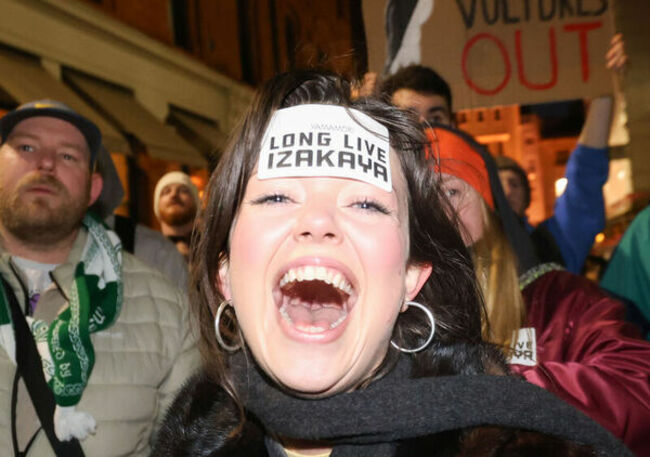
A protestor outside The Hoxton last night. Rolling News
Rolling News
“There is no logic that can be superimposed on the city; people make it, and it is to them, not buildings, that we must fit our plans”. Jane Jacobs.
Things like the Agent of Change principle, an idea that has been written into the Dublin Development plan but not yet legislated for, dictate that the onus is on the newcomer to manage the impact that their change brings to the area. In this case, noise mitigation. Rather than the burden being placed on the business or resident already in situ.
In relation to the most recent issue this week, The Hoxton Hotel parent company, Trinity Hospitality, said it had been left with “no choice” but to seek an injunction, citing multiple complaints from hotel guests and saying it could not use around a quarter of its rooms due to noise. In a statement, Yamamori said it found it “extremely difficult” to accept claims that the legal action was not intended to “curtail cultural or nightlife activity”.
Who is Dublin for?
Although the Dublin Development Plan contains some solid ideas, judging by recent years, it’s easy to see that for Official Ireland, economic progress tends to outweigh all else. The promised economic returns from large accommodation groups can easily override the best intentions in the Development Plan. We’ve seen this play out across the city, where the proliferation of hotels has steadily strengthened their hold on Dublin’s landscape and character.
People gathered on the junction of Exhequer Street and Dame Court for an outside clubbing and protest event last night. Rolling News
Rolling News
The Dublin City Development Plan 2022–2028 included a hard-fought-for requirement that developers allocate 5% of their space in major development projects, above 10,000 sqm, to cultural and communal facilities.
However, in July 2025, in a surprise move to councillors, Minister for Housing, Local Government and Heritage, James Browne removed the mandatory requirement for Communal, Community and Cultural Facilities.
A devastating blow, but even with the requirement in place, spaces that should have housed these much-needed creative spaces were built and left unfinished and empty. One example of this is the cultural space that was meant to replace The Tivoli Theatre. There’s a hotel there, but no active cultural space.
It’s not just clubs, pubs and cultural venues that are being affected by the international sale of the city. At the recent reopening of one hotel on George’s Street, a pocket park was absorbed into the hotel’s café and bar area.
While in Dublin 8, the history-rich quarter of the city, a slew of new hotels are absorbing every square inch, in an area where green spaces and community hubs are almost nonexistent. Access to long-promised green spaces and walkways is being locked behind gates in continued violations of planning permissions that are simply not being enforced. The latest development set for The Liberties is a new, 811-bed, seven-story hotel.
As part of the Newmarket Square redevelopment in Dublin 8, planning permission required a designated indoor market space at ground floor level — seen by Dublin City Council as key to maintaining the area’s market tradition and community character. However, the space that was built was unsuitable for a market, and the high rent made it commercially unviable to run a market.
“The point of cities is multiplicity of choice.” Jane Jacobs.
Just who are we building these for? Tourists. And what everyday benefit do local communities gain from these tourists? Well, they don’t provide football pitches or green spaces; they may boost the economy in the area, but the jury’s out when it comes to ‘trickle down’ to local communities.
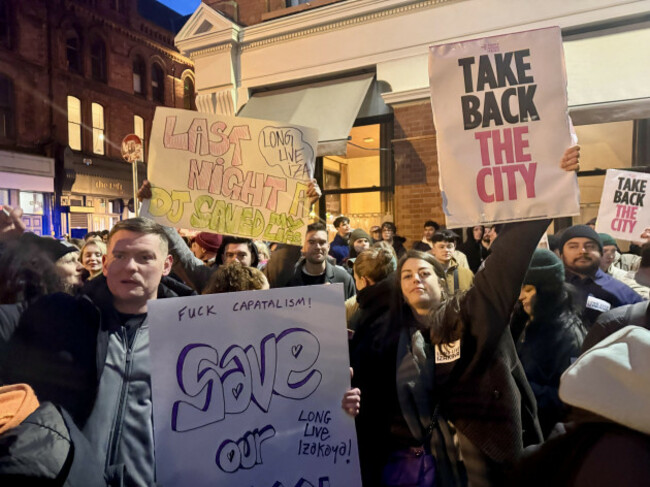
People attend a protest last night. Alamy Stock Photo
Alamy Stock Photo
The quality of life for local residents in these areas came up as a genuine concern in Dublin City Council’s own research on the issue last year. The ‘Your Dublin, Your Voice’ study found that while local communities have broadly positive interactions with tourists, they do have concerns about the additional strain on the city.
No one is against tourism or hotels in Dublin City, or any Irish city. Tourism is essential for a vibrant city to thrive. However, when the culture of the city is being hushed, endangered, bulldozed and eradicated to make way for a monoculture of investment opportunities for international funds, the question suddenly becomes, what’s left for the people who live here? And what will be left for the tourists to see and do?
What’s happening in Dublin reminds me of an open bus tour I once took in Varadero, Cuba. The tour simply stopped at every hotel on the peninsula. Is that where the city of Dublin is headed?
Won’t somebody please start thinking of the people who live here?
Andrea Horan is the founder of Dublin nail bar Tropical Popical, The Hunreal Issues, co-founder of No More Hotels, and co-presenter of podcasts Don’t Stop Repealin‘ and United Ireland.