


THE RECENT DISCOVERY of six dead bodies in Bulgarian mountains, likened to the “Twin Peaks” TV series, has sparked a wave of conspiracy theories fuelled by massive distrust in institutions.
Police found the corpses of three men – aged 45, 49, and 51 – in the yard of a private refuge earlier this month.
They had been shot dead and the refuge, near the Petrohan Pass in the country’s northwest, had been burned down.
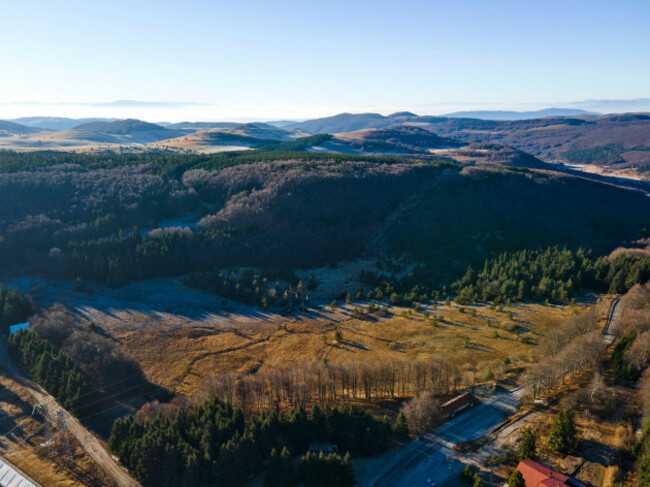
Aerial Autumn view of Petrohan Pass, Balkan Mountains, Bulgaria Alamy Stock Photo
Alamy Stock Photo
Two other men, aged 51 and 22, and a 15-year-old boy were reported missing.
Six days later, they were found shot dead in a camper van near Mount Okolchitsa, in the same mountain range.
Investigators said security cameras around the hut showed all six had lived there together until the morning of 1 February.
Three of the group, including the teenager, then left in a camping van.
The others stayed at the refuge before setting it on fire.
Three of the dead were officials with the National Protected Areas Control Agency (NPACA), an organisation that describes itself as a wildlife charity and organises outdoor camps for young people.
Several of the dead men had legally owned dozens of firearms.
‘MI6 and Mossad’
Police said the discovery was “unprecedented” and one prosecutor compared it to David Lynch’s iconic “Twin Peaks” series.
Investigators said murders and suicides were the most probable explanation for the deaths.
But a prosecutor, speaking before the results of any investigation, suggested the case might involve a sect and child abuse.
This has sparked a raft of conspiracy theories in Bulgaria, a country that ranks among the most corrupt in Europe and suffers from chronic distrust of institutions.
Many Bulgarians have rejected the version of events presented by the authorities.
Thousands have shared posts on social media alleging a plot involving a South American cartel, Russian services, human traffickers or a paramilitary organisation.
Others see the murders as an attempt at manipulation ahead of a snap election, scheduled for April, that was triggered by the resignation of the government after large anti-corruption protests in December.
Some of the conspiracy theories have been accompanied by AI-generated images, one showing commandos in black offroad cars driving away from a shelter.
“An elimination by MI6 and Mossad, with two teams in jeeps following a leak from the logistics centre (the shelter) about trafficking to Western Europe! All other versions are nonsense!” one user wrote.
‘Deeply rooted distrust’
Distrust has reached such a level that a public TV channel host asked the mother of one of the dead to show her identification papers live on camera to prove who she was.
On Wednesday, nearly 200 people gathered in front of the interior ministry to demand the minister’s resignation, while an online petition is urging an independent international investigation.
Joeri Buhrer Tavanier, a former advisor to the European Commission, said the public distrusted the courts, the police and all other institutions in a country that had failed to tackle “a high level of corruption” for decades.
“Distrust is deeply rooted because the institutions have not been able to show they serve the public” but instead often serve politicians and oligarchs, he told AFP.
They had now suffered “a new major blow, from which it will be very difficult to recover”.
Rositsa Dzhekova, a disinformation expert at the Center for the Study of Democracy in Sofia, said “the explosion of conspiracy theories… did not happen in a vacuum”.
Public distrust was exacerbated by “serious communication deficiencies” on the part of public institutions.
“That approach – partial information, strong suggestions, long stretches of silence – fuels rather than calms speculation.”
“When official communication is slow, fragmented or overly opaque, people fill the gap with narratives that feel emotionally coherent, often amplified by low-quality outlets,” Dzhekova said.
Two months before the election, “tragedies are easily instrumentalised to further polarise public opinion”, she added.