
Culture
Farewell to The Cloberer: Pogues drummer Andrew Ranken remembered


DCM Editorial Summary: This story has been independently rewritten and summarised for DCM readers to highlight key developments relevant to the region. Original reporting by RTE, click this post to read the original article.
Programme maker Mike Glennon remembers Pogues drummer Andrew Ranken, a member of the band for four decades, who has died aged 72.
This week The Pogues announced the death of drummer Andrew Ranken, acknowledging his status as the “heartbeat” of the band.
Known within the group as ‘The Clobberer’, Ranken was a vital part of the Pogues’ sound. In the band’s early days he often performed standing behind a stripped-back kit, providing the pummelling beat that propelled tracks such as The Sick Bed of Cuchulainn. Ranken also famously provided the title for the group’s second album Rum Sodomy & The Lash, often considered their masterpiece.
We need your consent to load this rte-player contentWe use rte-player to manage extra content that can set cookies on your device and collect data about your activity. Please review their details and accept them to load the content.Manage Preferences
Listen to The Lyric Feature: A Dream Of Foreign Lands
In 2025, I produced a documentary for RTÉ Lyric FM commemorating the album’s 40th anniversary and exploring its enduring creative and cultural significance. I had brief contact with Andrew Ranken while working on the programme.
While he was unable to be interviewed, he shared a written contribution with me. In what I suspect may transpire to have been his final media contribution, he responded to my requests for reflections on the origins of the album title, its themes and the band’s connections with London and London Irish audiences.
The title Rum Sodomy & The Lash, he wrote, “comes from Winston Churchill’s description of life in the British Navy, possibly brought to mind by George Melly’s rather more frivolously titled autobiography Rum, Bum and Concertina… It seemed to ring a few bells, and I think it resonated with several of the album’s recurring themes.”
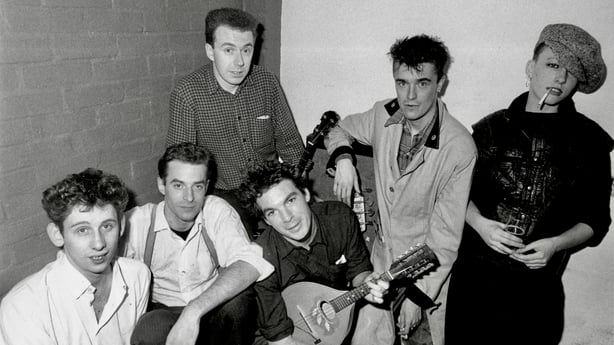
Of those themes, Andrew wrote, “I think it is a dark album, with death, war, drink and destruction all to the fore. To which may be added exploitation, both capitalist and sexual and an overall sense of painful and needless loss.”
This description of the record’s darkness speaks to its unflinching examinations of violence, poverty and depravity – heard in songs such as The Old Main Drag, in which a young Irish immigrant seeking to carve out a new life in London finds himself drawn into a world of prostitution, pills, police violence and abuse.
A Pair Of Brown Eyes, meanwhile, while deceptively pretty on first listen, reveals something darker beneath the surface – its narrator dulling their senses with alcohol, seemingly seeking to block out memories of the battlefield and “the arms and legs of other men scattered all around.”
The narrators within these songs reflect a recurring characteristic of the Pogues’ lyrics – a focus on exiled, marginalised, wounded or damaged individuals. Similarly, their audience often included those who felt, for one reason or another, excluded or disenfranchised – listeners who found a sense of solidarity within the band’s work.
The earliest manifestation of this solidarity was the deep connection the band forged with London Irish audiences in their formative years – an audience who often felt excluded on all fronts, neither fully accepted as Irish in Ireland nor English in England. During the 1980s, that community was further beleaguered by the political and social repercussions of the Troubles in Northern Ireland, with suspicion, hostility and media caricature shaping daily life in Britain for many of Irish background. In that context, the Pogues’ music offered more than entertainment; it provided a public assertion of identity at a time when Irishness in Britain was frequently politicised, misunderstood or marginalised.
“We were trying to do something new, and hopefully with a broader appeal. Some people got it, and some didn’t.”
Reflecting on that connection, Ranken wrote:
“I think we played a role of political solidarity and support for the Irish community in London, and the UK generally, at a time when it was beleaguered by Thatcher and the Conservative government and our hideous right wing press. When we started doing St Patrick’s Day concerts (and any gigs at all in fact) it always felt to me that a huge collective sigh of relief went up, because we were making a very positive statement about our Irish influences, and demonstrating that it was possible to do that and to have an enormous amount of fun at the same time.”
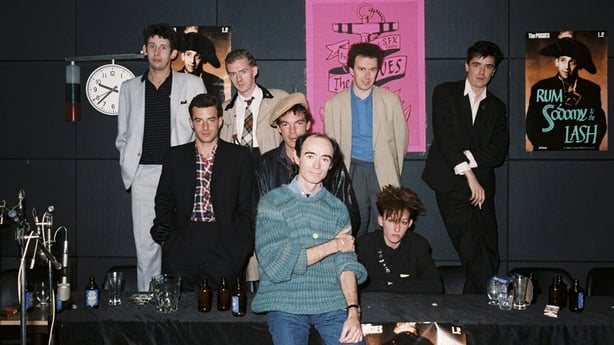
In Ranken’s recollection, the band’s music was never simply about nostalgia or revival. It was about creating a space in which diaspora identity could be celebrated rather than defended.
Not everyone, however, celebrated The Pogues’ arrival. For some in Ireland, their fusion of traditional Irish influences with punk attitude and energy was unwelcome and unwanted. It was made even more so by the fact that this was a band who had emerged from London and spoke with English accents. The hostility that surrounded the band in certain quarters found its most notorious expression during a broadcast of RTÉ Radio 2’s show the BP Fallon Orchestra recorded on September 5th, 1985, mere weeks after the release of Rum Sodomy & The Lash and at which point interest in the band was rapidly accelerating. Notoriously, the broadcast saw traditional concertina player Noel Hill describe the band as, “a terrible abortion of Irish music.”
Of this hostility, Ranken wrote:
“In Ireland there was some criticism initially that we were not really authentic, not Irish enough, and not playing our instruments properly enough. This misses the point that we were a London band and although we had some Irish roots and a shared love for Irish music, we were also heavily influenced by punk, and to some extent country and western, and never wanted to simply copy Irish traditional music.”
In Ranken’s telling, the tension between London identity and Irish tradition was not a problem to be solved, but the very space in which the band existed.
“We were trying to do something new, and hopefully with a broader appeal. Some people got it, and some didn’t.”