

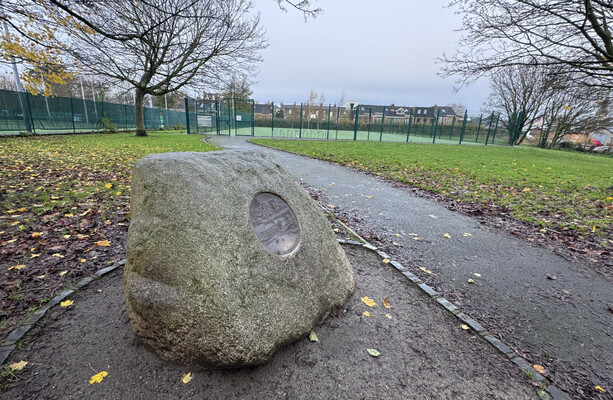
WITH THE RECENT media storm around the proposed renaming of Herzog Park in Rathgar, it is worth taking a look at the practice of naming and renaming places (and other things) in Ireland more generally.
The naming of places is one of the most basic, yet powerful and symbolic acts of geographical appropriation.
The naming of landmarks is also often deployed as an act of commemoration of individuals, organisations, and events.
Renaming places is therefore also a powerful act which can be controversial.
Indigenous Irish placenames have survived from earliest times to the present day through the Irish language. The oldest examples of these are our rivers, which are often named after Celtic Goddesses, e.g. An Bhóinn, An Bhandain.
Over time, many more named places emerged. Most of our 60,000 townland names came from the two-thousand-year-old Irish language and are therefore immensely valuable in terms of geographic, environmental, linguistic, social and political history. They provide a link to our culture before colonisation. Ironically, the British helped us preserve this link by not renaming these places on their maps (apart from Anglicising them).
Of course, while all of Ireland was once Irish speaking, Dublin developed largely under English rule (even though Irish would have been widely spoken there throughout history until more recent times).
This has meant that streets and landmarks were most often named to commemorate English people, places or events.
Some of this geographical appropriation was undone following the foundation of the Irish state with the renaming of many streets (e.g. Great Britain Street > Parnell Street), but many streets still reflect the English history of the city (while many later suburban Dublin streetnames are apolitical).
Interestingly, a certain amount of renaming was done in the Irish language only, where foreign names were Gaelicised during the Gaelic revival. This practice is no longer recommended, but the remnants of it can be seen on many old street nameplates, e.g. Cé na Buaidhe ‘The Quay of Victory’ [Cé Victoria], Sráid Dhún na Sméar ‘Fort of the Berries Street’ [Sráid Beresford]. So as the Irish versions of old Dublin streetnames are being de-Gaelicised, new streets are to be named in Irish only according to the current Dublin City Council Development Plan.
Names with meaning
Where I take an interest in this is the contemporary naming of new streets and the processes around this. Because of language legislation in this country (including the Constitution), new names have to be either in Irish only, or in Irish and English.
Moreover, the Placenames Commission produced guidelines in 1992, based on Government policy and legislation, that stated that the names of new roads, streets and districts should “relate to the physical environment and local history”.
These guidelines still apply today. For local authorities to implement such guidelines with regard to naming new places (streets, housing estates, neighbourhoods, etc.), there is an onus on them to consult with various local experts before naming a place.
In practice, however, new streets are often named by developers (or renamed by residents to help increase house prices, e.g. Ballymun Avenue > Glasnevin Avenue) with little regard for local history or otherwise.
This is how we end up with names such as Tiffany Downs and Chestnut Grove, names that presumably people like the sound of, but have no relationship to the place.
You might expect more of a furore over names like these, but they slip through the planning and naming processes more often than not without much resistance. Thankfully, there is a concerted effort recently among local authorities and their heritage officers to put an end to these practices.
The naming of major landmarks such as parks, bridges, train stations and airports garners much more attention understandably, especially if their naming commemorates a political figure.
Sometimes authorities play it safe and avoid naming them after people altogether despite a public desire to do so. Droichead an Dóchais in Galway is a possible example of this, where other names were in the mix, e.g. the 1916 rebel Julia Morrissey.
There are some examples of where major landmarks were successfully renamed (e.g. Marino Crescent Park > Bram Stoker Park) and there is of course our time-honoured tradition in Ireland of informally renaming them (e.g. The Harp Bridge [The Samuel Beckett Bridge]).
My interest is always piqued when I notice the other national language being used (in both directions) in acts of onomastic obfuscation in times of controversy or sensitivity (e.g. Irish Water > Uisce Éireann or Bord na gCon > Greyhound Racing Operations Ireland Ltd).
I would argue that, in general, more rigour should be applied to practice of naming so that renaming is required less often.
This would require there to be a placenames (and naming) committee in every Local Authority area.
Following best practice like this would help ensure names are chosen that work in both official languages and are linked to our cultural heritage where possible.
When renaming is required, however, legal and democratic processes should be followed ensuring the people have their say.
Brian Ó Raghallaigh is an Assistant Professor at Dublin City University. He is the Principal Investigator on the Logainm Placenames Database of Ireland project (www.logainm.ie).