

IN THE END, the country’s newfound and unprecedented optimism over the Metrolink lasted just 58 days.
First proposed over 20 years ago, it seemed last month that there was finally some forward momentum for the elusive public transport project. Planning permission was finally granted for the new metro, which would provide connectivity between Dublin city centre and Dublin Airport, as well as suburbs on either side of the Liffey.
Celebrations were in order at last as we learned that ground would finally be broken in 2027, just 22 years after someone first had the bright idea that a major city should probably have an efficient way of getting to and from one of the busiest airports in Europe.
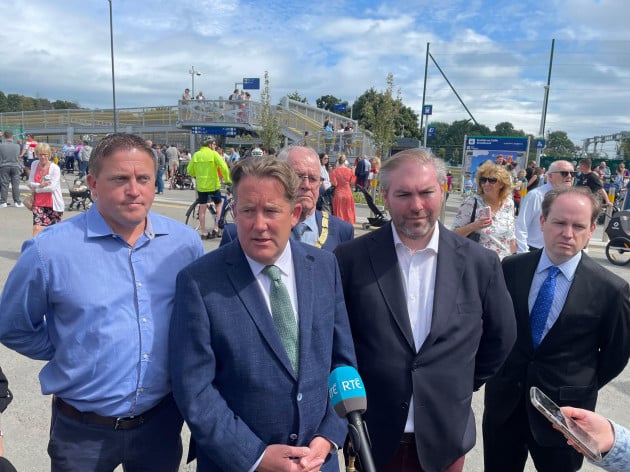
Greeting the decision, Minister for Transport Darragh O’Brien said: “A hugely significant day, MetroLink has been granted full planning permission. This transformative project will boost housing, jobs, growth & connectivity for Dublin and the airport. Funding is allocated, and now it’s time to deliver.”
Now, O’Brien has just come from his position as Minister for Housing, so in fairness to him, he hasn’t got a clue what hitting a target looks like. You might as well ask a medieval Irish monk to paint you a picture of an elephant. Nevertheless, when O’Brien made this announcement, there were almost certainly some members of the public who might have assumed that maybe there would be no more obstacles from this point forward. Something about the phrase “Now it’s time to deliver” had many people foolishly thinking that now it’s time to deliver.
Now, nobody can blame you if you shared in that optimism. God knows we’ll take any excuse these days. But unfortunately, it was very stupid of you to do so, wasn’t it? If 20 years of delays have taught us anything, it’s that there will be precisely one moment to celebrate the Metrolink, and that’s when you step onto it for the first time, with your half-AI grandchildren, in 2063.
Plans for the Metrolink have been thrown into disarray once more due to a legal challenge raised by 19 residents living near the proposed Charlemont stop. Construction around the stop will require the use of a laneway around the back of the houses, as well as causing the other inconveniences that come with living near the construction of an essential infrastructure project. This is the crux of the residents’ case against the Metrolink — sort of like Garth Brooks if he were a train.
Now, on the one hand, you might say that the government cannot be blamed for an eventuality in which fewer than two dozen residents of Ranelagh delay a crucial infrastructure project worth somewhere in the region of €10 billion. On the other hand… If the government didn’t see this coming, then they are the only ones who did not see it coming.
Did we assume that no inhabitants of one of Dublin’s famed leafy suburbs would take the opportunity to prioritise themselves here? We’re talking about a city in which residents of a suburb that neighbours Ranelagh once screamed bloody murder because they didn’t want to change their postcode to Dublin 26, for fear of association with the likes of Dublin 22 and Dublin 24 (up Firhouse), leading to the birth of ‘Dublin 6W’. Ranelagh, of course, remains D6.
More predictable than the NIMBYism was simply the sense that the Irish public would once again be left waiting for a train that isn’t coming. If anything, the most understandable concern that a resident of Dartmouth Square might have is that once ground is broken on the project that it will simply never be completed, and exist only as a mirage on the horizon, much like the National Children’s Hospital, the end of direction provision, the end of the housing crisis, night-time economy laws, the Occupied Territories Bill, hate-speech legislation, and all the other things we just don’t seem to be able to get over the line.
In that context, you can sympathise. No matter how important the Metrolink is, on what basis are we supposed to have faith that any of it will go according to plan? The government’s announcement of a 2027 start date, seemingly failing to anticipate the prospect of a challenge, is stark evidence of that problem: promising rather than planning.
Transport Infrastructure Ireland has already acknowledged the ‘inevitable delay’ the legal challenge will cause. Looks like you win this round, Ranelagh. And also, if you are a permanent resident of Ranelagh, probably most other rounds too. One hopes that a resolution can be found sooner rather than later, and the prospect of emergency legislation has been raised this week. One might argue that there is no need for such legislation. Perhaps if we give them a choice between this and being turned into Dublin 26, a compromise could be reached.
By the time the Metrolink is taking people to Dublin Airport, it’s entirely possible that the hub will be going by a different name.
This week, Fianna Fáil TD Malcolm Byrne suggested further cementing Fianna Fáil’s legacy as lifetime overlords of the Irish republic by bringing a bill before the Dáil to rename the airport in honour of former Taoiseach Seán Lemass.
There is no doubt that Lemass was a pivotal figure in Irish history, especially with respect to economic and infrastructural expansion. As a republican and former member of Michael Collins’ ‘Apostles’, one can see how his historical standing also works in his favour. If nothing else, it’s a less crazy suggestion than Eamon De Valera Airport or Charles Haughey Airport, the latter of which presumably already exists on Inishvickillane.
However, given that the suggestion comes at a time of political tumult for Fianna Fáil, one does wonder if it’s entirely appropriate for all of us to do what would essentially amount to a huge favour for them. We have plenty of people we could name the airport after that wouldn’t gift massive and free PR to one of our political parties, after all. Someone nice and undivisive, someone who everybody can get behind. Someone we all like. You know, like Bono or Bob Geldof.
But who can possibly predict what’s in the hearts and minds of Irish people anymore? You think you know a people and then you find out that 47,000 of them tried to sign up for the Dublin marathon this week. That’s nearly 2% of the country’s entire adult population. Not to discourage anyone from physical exercise, but what is going on there? Is it a penitence thing? Like we’ve shaken off the yoke of Catholicism, so now we need some other way to suffer before God?
Or maybe it’s simply a matter of practicality. That marathons are now the simplest way to transport people across the city. Maybe the Metrolink is even more urgent than we think.